

 Jar's (hopefully weekly) Review
...
Review 1: The music of Marie, by Usumaru Furuya
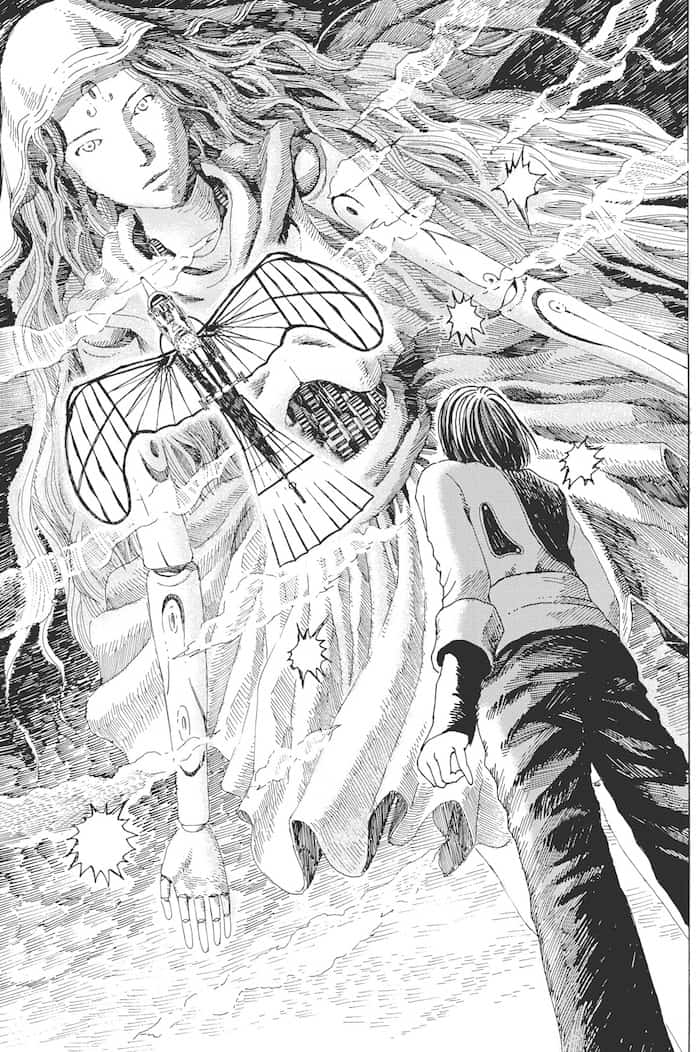
This is the manga that made me want to start this review, since I think this book should be definitely more known than it actually is. Furuya's artworks are stunning, especially the double spread panels: it has a vibe that reminds me of an artist my teacher told about in middle school (at the moment I don't remember his name: when I find it, I'll tell you). The plot of the story is quite interesting. The world has stopped its scientific evolution, but this doesn't imply its complete demise: on the contrary, all living beings are at peace and create a utopic society in which conflict is an alien concept. All of these creatures are protected and governed by a mechanical goddess, whose name is Marie, that flies around the world and creates a soothing music that can be heard only by some people, including one of the protagonists of the manga, Kai. I don't want to talk too much about the plot now, because it'd be pointless to make a summary of Furuya's work, so I'd much rather just give an overall impression, trying not to reveal too much about the plot. First of all, this is one of my favourite mangas by this author right now: I haven't read much, but I own Palepoli (might write a review of this, too. Not sure yet) and Sodoma 1985. One of the main themes faced in this book is the relationship between the Man and God, which is shown really accurately, anthropologically and philosophically speaking. The thing that fascinates me the most about The Music Of Marie is that it never really tries to give a complete and absolute answer to any of the questions it suggests to the reader: this is something that not many authors are able to do, I think. It's the reader's choice to give an interpretation of the ending and decide the meaning of the book. Probably, this whole manga comes from a conflictual view on religion from Furuya's perspective, which is noticeable even in other works of his (there are some references to various religions in Palepoli and Sodoma 1985). Anyways, Furuya's world building in this story is extremely precise and anthropologically interesting: from the representation of music, a key element in the whole story, to the religious ceremonies and events, the mangaka never fails to pleasantly surprise me. The amount of effort put into this fictional (?) world is totally perceivable. I found pretty interesting even the stories of background characters such as the scientist-priest of Marie: his figure highlights the contradictions of a character who serves both God and Science, trying to find a canal to connect them and achieve an interior cohesion of thought. There are many different topics that this book touches, even briefly, but I'll let you discover them by yourselves: in conclusion, I cannot recommend this manga enough and, if you're into philosophy and such, you'll probably like this!
Rating (out of 5):
P.S. Sorry for the shitty image positioning and bad writing, I kinda suck at coding and English isn't my first language 
P.P.S. Shoutout to Nukocities for making these beautiful act emotes: I can't stop using them lol