 Jar reviews stuff
DISCLAIMER: I am, by no means, an expert critic and these reviews are just my personal opinions. Please, if you are interested in any of the things mentioned here, go check official sites made by competent people! Also, some of the media reviewed here may be rated R, just so you know in advance :). Also, my ratings may seem very generous to some people, but I usually don't write bad reviews unless what I'm reviewing is so bad I need to scream to a wall about it.
...
The music of Marie, Usumaru Furuya
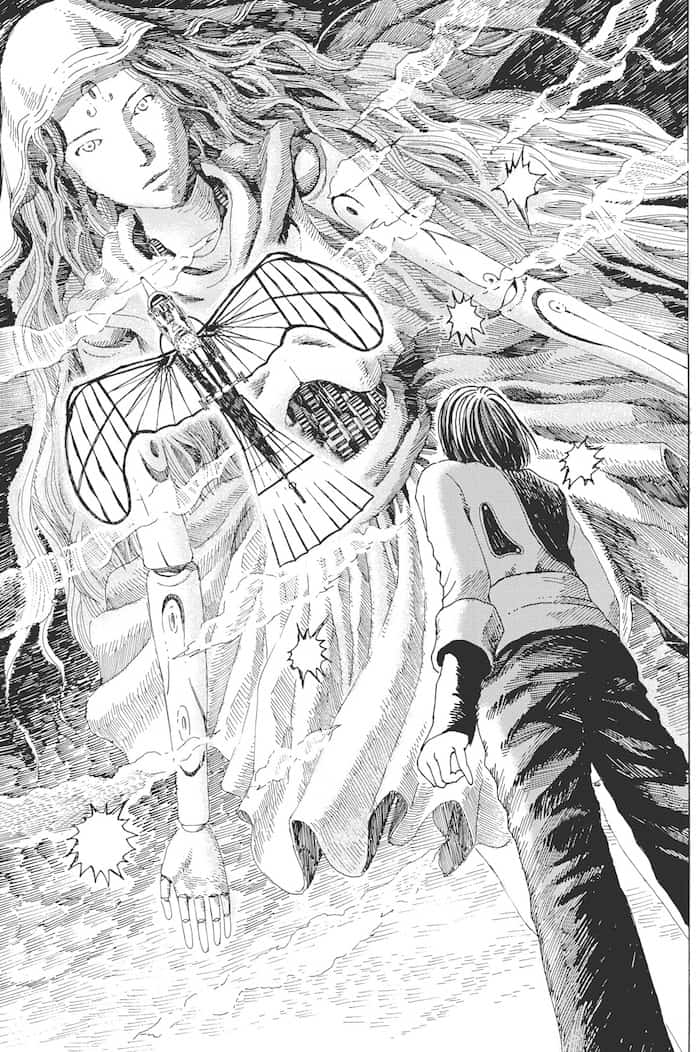
This is the manga that made me want to start this review, since I think this book should be definitely more known than it actually is. Furuya's artworks are stunning, especially the double spread panels: it has a vibe that reminds me of an artist my teacher told about in middle school (at the moment I don't remember his name: when I find it, I'll tell you). The plot of the story is quite interesting. The world has stopped its scientific evolution, but this doesn't imply its complete demise: on the contrary, all living beings are at peace and create a utopic society in which conflict is an alien concept. All of these creatures are protected and governed by a mechanical goddess, whose name is Marie, that flies around the world and creates a soothing music that can be heard only by some people, including one of the protagonists of the manga, Kai. I don't want to talk too much about the plot now, because it'd be pointless to make a summary of Furuya's work, so I'd much rather just give an overall impression, trying not to reveal too much about the plot. First of all, this is one of my favourite mangas by this author right now: I haven't read much, but I own Palepoli (might write a review of this, too. Not sure yet) and Sodoma 1985. One of the main themes faced in this book is the relationship between the Man and God, which is shown really accurately, anthropologically and philosophically speaking. The thing that fascinates me the most about The Music Of Marie is that it never really tries to give a complete and absolute answer to any of the questions it suggests to the reader: this is something that not many authors are able to do, I think. It's the reader's choice to give an interpretation of the ending and decide the meaning of the book. Probably, this whole manga comes from a conflictual view on religion from Furuya's perspective, which is noticeable even in other works of his (there are some references to various religions in Palepoli and Sodoma 1985). Anyways, Furuya's world building in this story is extremely precise and anthropologically interesting: from the representation of music, a key element in the whole story, to the religious ceremonies and events, the mangaka never fails to pleasantly surprise me. The amount of effort put into this fictional (?) world is totally perceivable. I found pretty interesting even the stories of background characters such as the scientist-priest of Marie: his figure highlights the contradictions of a character who serves both God and Science, trying to find a canal to connect them and achieve an interior cohesion of thought. There are many different topics that this book touches, even briefly, but I'll let you discover them by yourselves: in conclusion, I cannot recommend this manga enough and, if you're into philosophy and such, you'll probably like this!

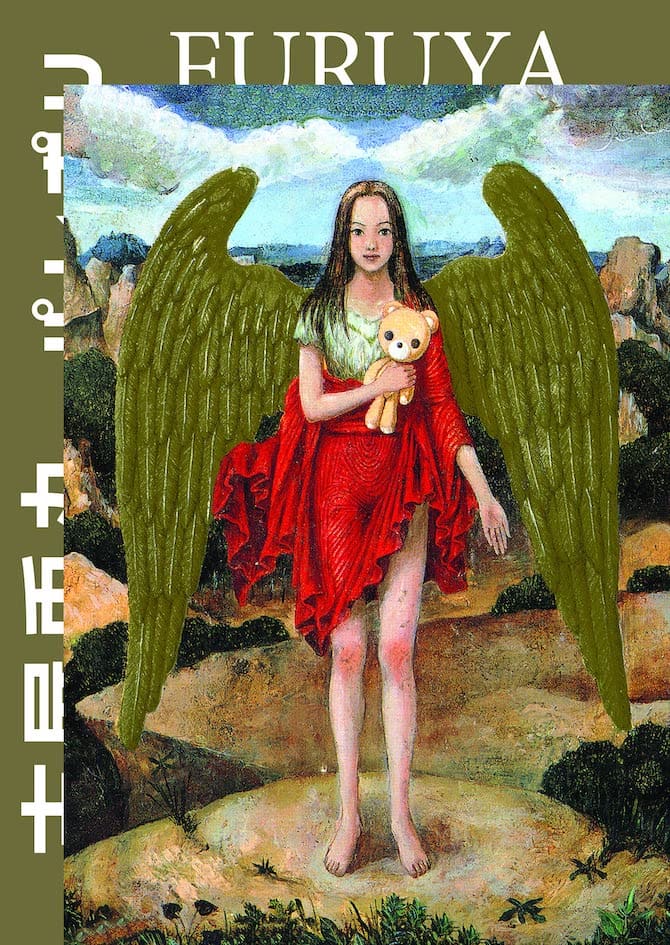
Palepoli, Usumaru Furuya
I'm finally back (strangely I've been able to mantain my writing schedule and I'm posting this 1 week after the previous review) and I'm talking, again, about Furuya's mangas. I have to be honest: I haven't read a lot of stuff by Furuya, but some of his works are extremely well made and I absolutely recommend you to read them! I finished Palepoli two weeks ago and I really enjoyed the format of the manga: it doesn't follow a single storyline, but it's a collection of different stories that gradually progress together (every "chapter" contains various yonkoma -4 panels short stories- with different storylines and characters from different yonkoma interact with eachother during the progression of the book). I've probably explained this very badly, sorry lol. Anyways, the comic strips mostly discuss themes such as religion or social/institutional/juridical issues, while some of them are actually just intelligently displayed meta-yonkama (4th wall breaking kinda stuff, y'know). There are LOTS of pop culture references and, gotta be honest, I didn't get some of them (especially the ones from Japanese songs or cartoons). My favourite parts of the collection were the Takashi ones: they're about a child called Takashi that tries to discover the world; the ending panel always shows Takashi's mother telling him to hurry up because he's getting distracted: I really liked this, because it kinda resembles my own experience with the discorvery of life. I think society (which Takashi's mother is an allegory of) forces individuals to a very sudden and fast growth: "immaturity" and childlike behaviours are often stigmatised, even in literal kids. I've always believed that an attitude towards life that doesn't encourage distracting and "wasting time" is inhuman: it's simply impossible, at least for me, to live without the joy of not having a purpose, just discovering things and wandering around. Idk if this makes sense and, again, I can't fucking speak English, but you get what I'm saying, right? I totally recommend Palepoli, go check it out! :)
Sodoma 1985, Usumaru Furuya
Good afternoon (writing this at 6pm) my fellows! Oh, well: I guess I am still not able to keep doing stuff regularly, so I'm here today with this review, probably like 3 week late idk. (I've been pretty busy with projects, school etc. lately TuT). Anyways, I've read this manga in way too much time bc I randomly stopped reading at some point since I was burnt out, but then I finished it and it was pretty good (sorry for the bad English, I'm pretty tired rn lol)! So, this manga contains different mini-stories, like other works by Furuya, but the best ones were Sodoma 1985 (the main story) and Schoolgirl (I won't bother to check if I'm right but ig that was a manga adaptation of Schoolgirl by Dazai?). I really enjoyed the autobiographic insight in Sodoma and tbh now I totally get where Furuya comes from and how his art was influenced by different media, while Schoolgirl was a pretty good adaptation imo, but I'd have to actually read the original book to talk about that: I totally wanna buy more stuff by Dazai, but I don't usually find much in my area -_- (the only book I could find is No Longer Human. It was great! My Literature prof. gifted a copy of ti to my Latin and Greek teacher lmao). Anyways, back to Sodoma 1985: I found the whole feeling of wanting to escape from your town lowk relatable and it isn't generally that much of a story, but it was still pretty nice to read. In conclusion, I'd say this is a pretty good book, but tbh I recommend reading his other manga before this :).

Accepted (2006)
Hello everyone: I've finally decided to review something new! I have to admit this is not the type of movie I'd usually talk about here since I don't usually watch a lot of 2000s highschool comedies/movies, but this film, despite not being meaningful, emotional or whatever, was indeed entertaining. I have no idea of why I liked it so much, but I guess that it's because the plot is kinda engaging (it is not "realistic", but that doesn't mean it's bad): the movie is basically about some guys who get rejected from college and decide to create their own fake college to hide the fact that they weren't accepted from their parents, but then the whole things starts getting out of hand when people start applying for the fake college. I'm not really recommending you to watch Accepted because, let's be honest, considering the whole thing objectively, it isn't an interesting movie. I liked it though, I guess I just needed something light after 2hrs of researching stuff for school (istg I hate Bertolt Brecht with a passion T-T).

This image feels so 'Murican
Rating (out of 5):
Midori - the Camellia girl (1992)
Hullo everyone! Today I'd like to talk about this movie which is appearently pretty controversial. So, uh, yeah. While I was casually looking at random stuff on Pinterest I found someone talking abt this film and I thought I'd give it a try, even though a lot of people say it's shit. And ngl, I liked the movie. Now, before you think I'm tryna be edgy bc "omg yes gore is so funny" and close this page thinking I'm an idiot, please let me explain. I knew Maruo and his work before watching Midori (Furuya mentions him quite often, actually), so I was aware of what I was going to watch and this gave me at least a context in which to put this work: it is quite clear that the acts of violence committed both in the movie and in the manga are not by any means glorified. Well, part of the point of Midori is contrasting the state's tendency to value wrks depicting nice aspects of its society, leaving behind or censoring what is conceived as horrid or inconvenient. I appreciated the fact that none of the characters presented in the movie are "edulcorated": the freaks are real freaks, not just people who are different from a supposedly homologated crowd but still near to our principles enough for the viewer to empathize with. I think that the whole concept of this story is in strong opposition with Japan's shift toward "westernization" (is this the correct term?) and increment of soft power (do you remember that dumb wojack meme with the "place, nation x" and "place, Japan"? Kinda like that. I swear I'm not hallucinating it, this meme exists) both by creating such a gruesome atmoshpere/story and by favouring a narrative inspired by kamishibai, a form of Japanese street theatre popular during the 1930s (the period where the film is set), the first accounts of which date back to the 8th century (I totally haven't searched this up on Wikipedia, nah...). All this being said, is the movie good? Imo, yes. Is it a masterpiece? Eh, idk: it is surely one of the most known works of the ero-guro genre and it attracts many viewers/readers because of its distribution being banned in many countries (or, at least, that's what people say about it); artistically, I'd say the manga is really well done and I gotta respect the grind bc Hiroshi Harada drew the entire anime movie ALONE and BY HAND. BUT, after all, while I do appreciate some of the symobolism, I still don't get some of the scenes. I don't know how to interpret the open ending, but I don't think that's a bad thing; [SPOILERS] I do have some hypotheses though: maybe the story is an endless cycle and repeats itself forever (the beginning and ending of the movie have the same imagery, so I guess that could be possible), or maybe Midori hanged herself (the whole thing about the camellia's neck beraking and the golden rope etc. Moreover in China the camellia is considered a symbol of eternal union: the petals represent the woman, and the calyx represents the man. That being said, maybe the neck breaking also means that the bond between Midori and Masamitsu can only be broken by Midori's death).[END OF SPOILERS] In conclusion, I have mixed feelings about the movie: it is indeed disturbing, but I think that it was kinda worth watching.

Yes, this is the manga cover, not the movie one. I just think Maruo's artstyle is neat so I put this as the description image
Rating (out of 5):